

PHONE / WHATSAPP / WECHAT
ADDRESS
South Of Wensheng Street, West Of Xingan Road, Weifang, Shandong, China
| Chemical Name | Baking Soda / Sodium Bicarbonate |
| Molecular Formula | NaHCO₃ |
| Product Appearance | White fine crystals |
| Product Specifications | Industrial Grade Standard: GB/T 1606-2008 Food Grade Standard: GB1886.2-2015 |
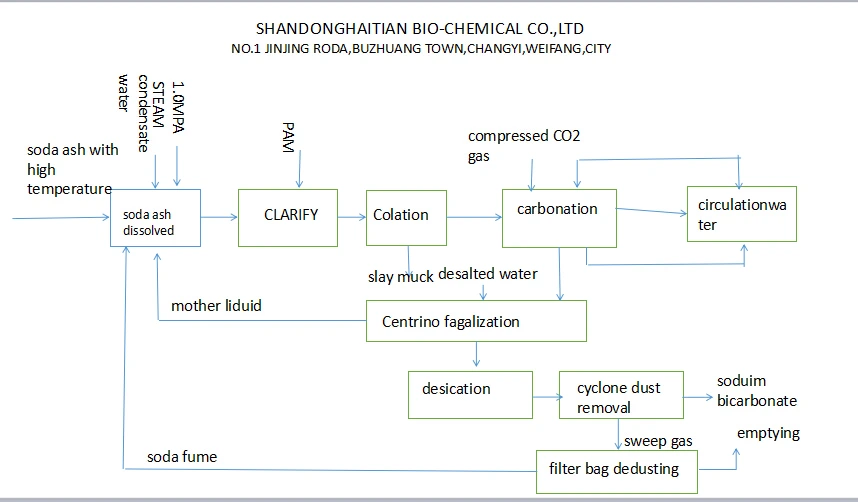
| Production Processes | Synthetic Method; Double Decomposition Method; Trona Method |
Sodium bicarbonate is white crystals or opaque fine monoclinic crystals with a specific gravity of 2.15. It is odorless, salty, soluble in water and slightly soluble in ethanol. Its aqueous solution is weakly alkaline due to hydrolysis. It remains stable at room temperature but decomposes easily upon heating, gradually decomposing above 50 °C. It does not change in dry air yet decomposes slowly in humid air.
Solubility data: freely soluble in water; 7.8 g at 18 °C, 16.0 g at 60 °C.
It decomposes readily when heated and slowly in humid air, fully converting to sodium carbonate at 100 °C. It decomposes rapidly in weak acids. Its aqueous solution starts releasing carbon dioxide and sodium carbonate at 20 °C and decomposes completely when reaching the boiling point. It dissolves in 10 parts of water at 25 °C and 12 parts of water at approximately 18 °C, and is insoluble in ethanol. An unstirred cold aqueous solution of sodium bicarbonate only shows a weak alkaline reaction on phenolphthalein test paper; its alkalinity rises upon standing or heating. The pH value of a freshly prepared 0.1 mol/L aqueous solution at 25 °C is 8.3. It is low-toxic, with an oral LD50 (rat) of 4420 mg/kg.
1.It is the most widely used leavening agent in the food industry, applied in the production of biscuits, pastries, steamed buns, bread, etc. It also acts as a carbon dioxide generator in carbonated drinks. Sodium bicarbonate generates carbon dioxide gas when heated.
2.It can be compounded with alum to make alkaline baking powder.
3.Used as a detergent for wool.
4.Applied in leather tanning, mineral processing, smelting, metal heat treatment and other fields.
5.Used for manufacturing acid-base fire extinguishing agents and foam fire extinguishing agents in fire-fighting equipment.
6.In the rubber industry, when combined with alum and H blowing agent, it achieves uniform foaming for the production of rubber and sponges.
7.Used as a flux for steel ingot casting in the metallurgical industry, and as a forming auxiliary for sand molds in steel casting (sand casting) within the machinery industry.
8.Serves as a color fixing agent and acid-base buffer for dyeing and printing, as well as a post-treatment agent for textile dyeing and finishing in the printing and dyeing industry.
9.Foaming agent, based on the principle that sodium bicarbonate releases gas under high temperature.
10.Desulfurization. Since the main desulfurization product of sodium bicarbonate is sodium nitrite, it boasts relatively broad application prospects in the glass industry.
11.Adding sodium bicarbonate to feed can supplement the carbonate loss in poultry blood caused by thermal panting (excessive exhalation of CO₂), thus improving calcium metabolism of the organism.
12.Supplementing sodium bicarbonate in feed enhances phosphorus mobility in laying hens, maintaining the optimal blood phosphorus concentration required for eggshell formation.
13.Sodium bicarbonate added to feed provides a sodium source to maintain an appropriate sodium concentration in blood.
Food Grade Standard: GB1886.2-2015
| Item | Grade |
|---|---|
| Total Alkalinity (as NaHCO3), % | 99.0–100.5 |
| Arsenic (As) Content, % | ≤0.0001 |
| Heavy Metals (as Pb) Content, % | ≤0.0005 |
| Loss on Drying, % | ≤0.20 |
| pH Value (10 g/L aqueous solution) | ≤8.5 |
| Ammonium Salt | Pass the test, comply with standard |
| Clarity | Pass the test, comply with standard |
| Chloride (as Cl−) mass fraction, % | ≤0.40 |
| Whiteness | ≥85 |
Industrial Grade Standard: GB/T1606-2008
| Item | Grade | ||
|---|---|---|---|
| Class Ⅰ | Class Ⅱ | Class Ⅲ | |
| Total Alkalinity (as NaHCO3), w/% ≥ | 99.5 | 99 | 98.5 |
| Loss on Drying, w/% ≤ | 0.1 | 0.15 | 0.2 |
| pH Value (10 g/L aqueous solution) ≤ | 8.3 | 8.5 | 8.7 |
| Chloride (as Cl−), w/% ≤ | 0.1 | 0.2 | 0.5 |
| Iron (Fe), w/% ≤ | 0.001 | 0.002 | 0.005 |
| Water Insoluble Substance, w/% ≤ | 0.01 | 0.02 | 0.05 |
| Sulfate (as SO42−), w/% ≤ | 0.02 | 0.05 | 0.5 |
| Calcium (Ca), w/% ≤ | 0.03 | 0.03 | 0.05 |
| Arsenic (As), w/% ≤ | 0.0001 | 0.0001 | 0.0001 |
| Heavy Metals (as Pb), w/% ≤ | 0.0005 | 0.0005 | 0.0005 |
PHONE / WHATSAPP / WECHAT
ADDRESS
South Of Wensheng Street, West Of Xingan Road, Weifang, Shandong, China
Copyright © 2026 by Weifang Haizhiyuan Chemistry And Industry Co., Ltd. All Rights Reserved